CPG Recruiters Bentonville AR
479-285-2262

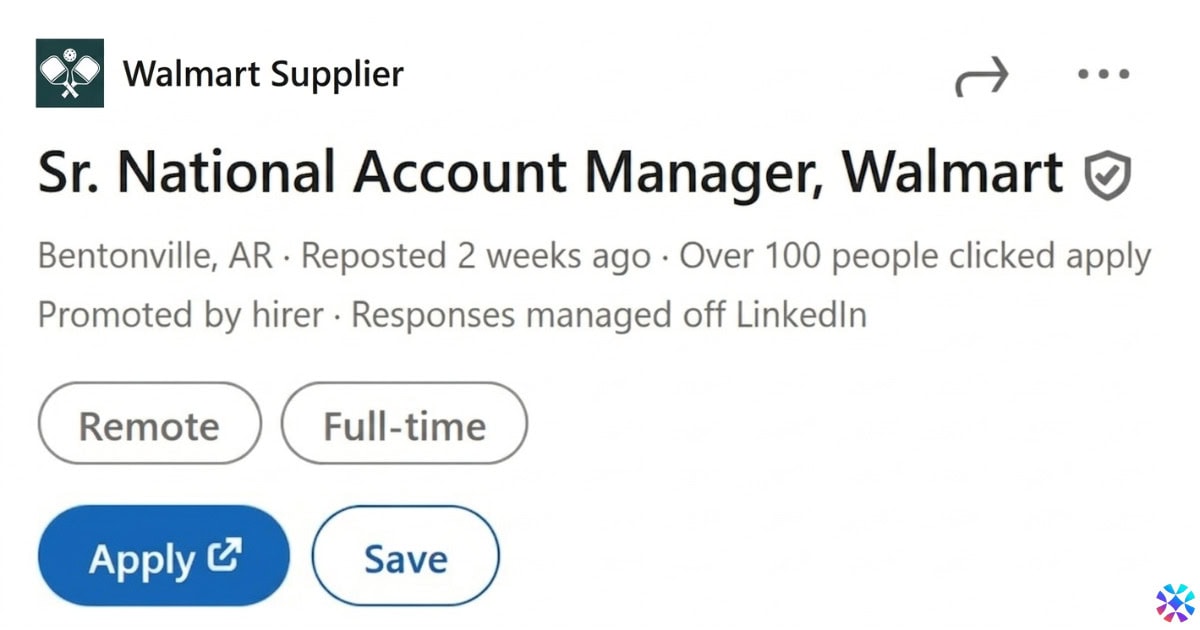
Take a look at the image above.
Over 100 people clicked “apply” for a Sr. National Account Manager, Walmart position.
At first glance, that sounds like a win. More interest. More options. More chances to find the right person.
But this is where many hiring processes start to break down.
Because what companies are getting isn’t 100+ qualified candidates. They’re getting 100+ applicants. And that distinction matters.
This is an actual position that was posted. The company name and logo were changed to protect their identity. LinkedIn stops displaying the exact count after it crosses 100. So whether it’s 101 or 500, it will still show “100+.” Which means the real number could be significantly higher.
Here’s where it gets interesting.
This company has reposted this role at least three times, and each time it generated 100+ applicants. The original posting dates back roughly eight months. These aren’t new roles—they’re replacements for someone who left the company.
How do I know? The company reached out to us 8 months ago but decided they didn’t want to spend the money on recruiting.
So despite hundreds (and likely far more) applicants, the position remains open.
That should raise a bigger question.
In today’s hiring environment—especially in consumer goods—posting a role online can generate significant volume very quickly. But volume creates a false sense of progress.

Many applicants don’t have relevant Walmart or retail experience, haven’t managed similar account complexity, and are applying broadly rather than intentionally. But we can’t blame anyone for trying to make a career move and applying, even if they’re overqualified or lack the necessary experience.
So instead of evaluating a focused group of strong candidates, hiring teams are forced into filter mode. They spend time eliminating instead of identifying. That shift—from finding talent to sorting noise—is where things start to go sideways.
More applicants should mean faster hiring. In practice, the opposite happens.
Resume review becomes a bottleneck. Sifting through dozens or hundreds of resumes takes real time. Qualified candidates get delayed, sitting in the same pile as everyone else. They also get lost in the mix and can be overlooked.
Meanwhile, top talent moves quickly and won’t wait through a slow or unclear process. Hiring managers get pulled away from running the business to review resumes, stretching what should be a 4–6 week process into 8–12 weeks or longer.
Most companies don’t think of applicant volume as a cost issue, but it is.
Internal labor adds up quickly as teams spend hours reviewing, screening, and coordinating interviews for so many applicants. There’s also the opportunity cost of an open role. In a Walmart-facing position, every week without the right person can impact revenue, execution, and customer relationships. After a long process, teams are more likely to settle just to fill the role, increasing the risk of a mis-hire. If that hire doesn’t work out, the process starts over—with even more time and cost invested.
And then there’s the part most companies underestimate—reputation.
When companies are overwhelmed with applicants, the candidate experience usually suffers. Candidates apply and never hear back. Processes become slow and inconsistent. Strong candidates interpret that as a signal about the company itself.
In the consumer goods and Walmart supplier ecosystem, it’s a small world. People talk.
Now layer that onto a role that’s been open for months and reposted multiple times.
Can you imagine the amount of time and cost that’s gone into this search? More importantly, think about how the market perceives it. Candidates see the same role posted again and again and start to draw their own conclusions.
Most hiring challenges stem from a lack of alignment.
What does success in the role actually look like? What level of experience is truly required? What is the company willing to pay for that level of talent? How will candidates be evaluated—and how quickly?
When those questions aren’t clearly answered upfront, the market responds with noise, and the company is left trying to sort it out in real time.
There has to be a strategy for hiring to have the most success. The “post and pray” method usually gives you the lowest ROI.
The companies that consistently hire well don’t rely on volume. They focus on alignment and precision. A clearly defined role, a tight profile of what “great” looks like, and an efficient interview process lead to better outcomes across the board. Time to hire decreases, costs are controlled, candidate experience improves, and offers are more likely to be accepted.

Posting a job and getting hundreds of applicants feels productive. But more applicants does not mean better outcomes. In many cases, it creates slower hiring, higher costs, increased risk, and long-term reputation damage.
The goal isn’t more applicants. It’s better alignment—and access to the right candidates from the start.
